
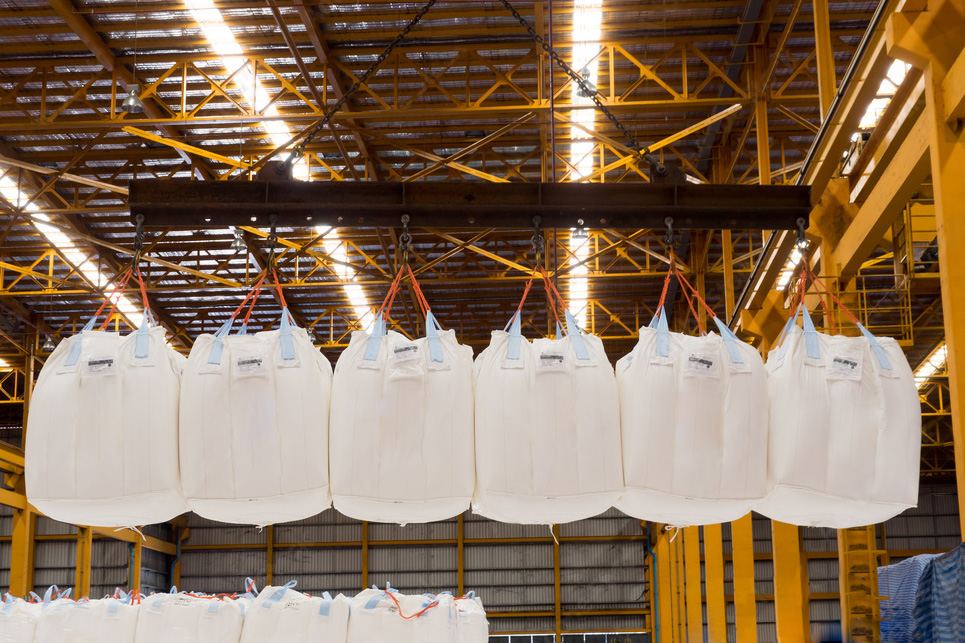
The right industrial packaging option has a significant impact on a company’s profitability, productivity, and supply chain integrity. Making the wrong choice can result in damaged products, unnecessary freight costs, lost warehouse space, and it could cost your business hundreds of thousands of Rands in losses and inefficiencies.
Balancing the initial cost with adaptability, durability, and flexibility should be the aim of every procurement manager when looking for industrial packaging. For South African companies handling large quantities of bulk goods, this choice comes down to a variety of factors. Some industrial packaging solutions tick multiple boxes, whereas others are only good at one or two things.
Custom Bulk Bags (CBB) is a manufacturer and supplier of bulk bags in South Africa. We produce 3.5 million bags a year – all of which can safely hold between 500kg and 2000kg each. Our products are highly flexible, durable, customisable and affordable, which makes them a great choice for industrial uses.

Bulk bags are affordable and versatile industrial packaging options
In practically every significant industry, from mining and agriculture to chemicals and food processing, bulk bags have become the norm for handling bulk materials. Their benefits are evident and convincing. They have an outstanding load capacity (hundreds of kilograms of material can be securely stored in a single bag). Their low packaging-to-product weight ratio significantly lowers overall shipment weight and freight costs.
Compared to a bulk bag, the average unit cost of an equivalent capacity in drums or cardboard boxes is substantially higher. What’s more, the cost per kilogramme of product packaged is significantly lower because one bulk bag can replace dozens of smaller containers.
Bulk bags are incredibly flexible, as their name suggests. They can be folded entirely flat when empty, reducing the amount of space needed for storage at your warehouse and the expense of sending empty bags to your location. Compared to rigid containers, this is a huge advantage.
They are appropriate for a wide range of products, including fine powders, granules, and pellets, because they can be customised with features like inner liners for moisture protection, UV-stabilised fabric for outdoor storage, and unique filling and discharge spouts.

Steel drums are more expensive but highly durable
Both steel and plastic drums are renowned for their strong, inflexible design. For some products, especially liquids, semi-liquids, and extremely dangerous compounds that need strong containment against impact or puncture, they provide unparalleled protection.
Their main disadvantage is that they are costly, heavy, and inflexible. Their capacities are limited to 208 litres, and when empty, they take up a lot of space, which raises the cost of storage and inbound freight. When compared to the effectiveness of a bulk bag, the high expense of a drum is hard to justify for dry, free-flowing bulk materials.
Cardboard boxes and cartons are affordable but not durable
For many large, non-hazardous items, industrial-sized cardboard boxes and cartons provide a cost-effective and adaptable solution. They can be stacked, are lightweight, and are simple to assemble. However, their main vulnerability is moisture and water, which seriously jeopardise their structural integrity. Cardboard softens and collapses when exposed to high humidity or water, which could result in product loss and warehouse safety risks.
Despite their strength, they are unable to securely lift or support the same concentrated loads as bulk bags without being carried on a pallet, which increases weight and expense. They are also susceptible to contamination risks. Cardboard is less suitable for high-hygiene applications due to its porosity and difficulty in cleaning.
They are a good option for products that need to keep their structural integrity and need less barrier protection, but they can’t match bulk bags in terms of heavy load capability or moisture resistance.

Hessian sacks are a natural, compact substitute
Hessian sacks are made of jute or other natural fibres. They are comparable to bulk bags in that they are strong, adaptable, and flexible within their bounds. They are often used for keeping perishable agricultural products (like potatoes or coffee beans) that require ventilation because of their breathability and biodegradable qualities.
Hessian sacks, however, prohibit widespread application in industrial logistics because they are only appropriate for lighter weights – usually between 25 and 100kg. They are not made to match a bulk bag’s two-tonne capacity.
Hessian is not often used for the large-scale transportation of raw materials between factories or during initial processing, but rather for end-user applications or retail-ready quantities. Untreated hessian is naturally absorbent and permeable, but improper storage can cause it to retain moisture and possibly grow mould or mildew.

Choosing your industrial packaging supplier
The ideal industrial packaging solution strikes a perfect balance between the cost per kilogramme of product and the strength and durability needed to keep the product safe. Bulk bags offer the best range of qualities for most dry and granular products. Finding the right manufacturer of bulk bags can save you a lot of money.
Look for a supplier that provides in-house quality control for ensuring safe operating loads and fabric strength. CBB performs a variety of tests to guarantee the quality of its bulk bags. We offer UN-certified designs, which are essential for hazardous materials, as they conform to strict international safety standards.
We also offer complete customisation and are able to modify bags with inner liners, baffles, and particular discharge systems to fit your particular needs. We offer all of this without the lengthy lead periods and currency uncertainties connected with imported bulk bags. Please contact us today for more information about our FIBCs or to get a free consultation.
___
Custom Bulk Bags is a major South African manufacturer of woven polypropylene bags for various industries, including mining, chemicals and agriculture. We are a Level 2 B-BBEE supplier that falls under the ownership structure of Deneb Investments Limited. For more information on our products, contact sales@custombulkbags.co.za.
