
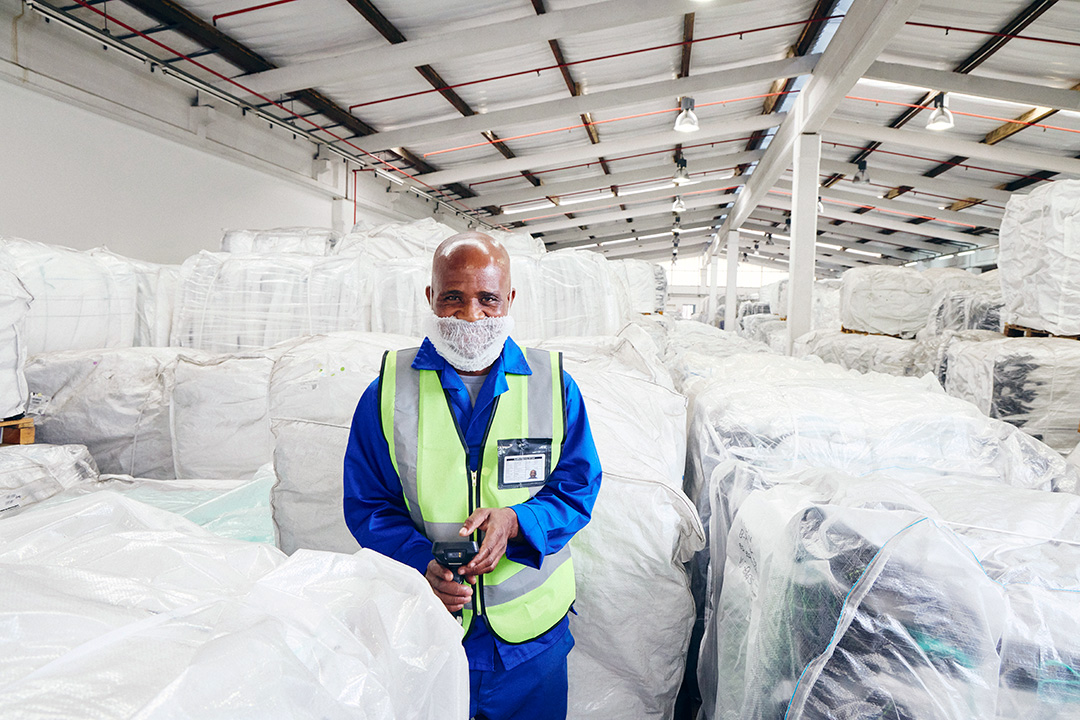
Efficiency is a key metric for South African companies and their packaging. Bulk bags, sometimes referred to as flexible intermediate bulk containers (FIBCs), are a simple but highly effective logistical tool used by top businesses in the construction, mining, agricultural, and chemical industries for storing goods and materials.
FIBCs are ideal bulk packaging and storage products due to their enormous capacity (up to 2 tonnes), affordability, and longevity, whether they are used to manage grain harvests in the Free State or transport tonnes of chrome concentrate from the Bushveld Igneous Complex.
However, the way in which bulk bags are handled when not in use has a significant impact on their longevity and safety. Storing empty bags incorrectly can result in material deterioration, safety risks, and financial loss.
Custom Bulk Bags (CBB) is a leading local manufacturer and supplier of customised FIBCs. We produce 3.5 million bulk bags annually, ensuring that you are always stocked. We extrude and weave our own premium polypropylene fabric and manufacture everything in-house. This makes them an affordable and versatile packaging solution for various industries.

The right conditions for storing FIBCs
The main component of FIBCs, woven polypropylene (PP), is extremely robust yet vulnerable to a few environmental factors. The climate of South Africa, characterised by high UV radiation and fluctuating humidity levels, can cause polymer chains to break down if bags are left out in the open. This results in brittleness, which can cause a bulk bag to fail when it is fully loaded.
FIBCs can be reused a few times before they need to be recycled. You can protect your investment and your employees by putting in place strict storage protocols:
1. Completely clean and discharge – A bulk bag needs to be emptied before storing it. In particular, organic materials or reactive chemicals can cause mould and mildew, contamination, and weight imbalances. The bags may become unstable when stacked and challenging to fold due to hardened residue at the bottom. Before folding, use a high-pressure air blower or an industrial vacuum to get rid of any dust or fine particles.
2. Correct folding methods to optimise room – The fact that FIBCs can be folded flat is one of their best features. Their storage footprint is minimal, enabling you to keep thousands of units in a comparatively small space. The accordion fold involves gusseting the sides inwards after placing the bag flat on a spotless surface. To ensure that the bag is a uniform width, align the seams. Fold the entire unit in half after folding the top down and the bottom up to meet in the centre. Ensure that the lifting loops are securely tucked into the folds.
3. Protection and covering – Dust, moisture, and pests can damage bags within a warehouse. Similarly, UV damage can result from sunlight coming through warehouse windows. Bags should always be kept out of direct sunlight by covering them with a tarp or plastic sheet. If polypropylene is stored in high-humidity conditions for long periods of time, it may lose its strength. Make sure your storage area is dry and well-ventilated. After arranging a stack of folded bags on a pallet, cover the pallet with a sturdy, UV-resistant tarp or wrap the pallet in stretch wrap to keep pests out.
4. Vertical stacking and palletising – You should make use of vertical space to reduce warehouse rental expenses. Use the first-in, first-out (FIFO) rotation technique to guarantee that older bags are used first and avoid any one batch being in storage for an extended period of time. Mark each pallet with the date of storage. Make sure the base of the stack is level when piling pallets of empty bags on top of one another. Avoid over-stacking; empty bags are lightweight, but if you stack them too high, the bottom bags may get permanently wrinkled or distorted at the seams.

The advantages of folding flat
One important factor influencing cost-effectiveness is the ability to compress bulk bags while not in use. Let’s consider the following comparison: whether filled or empty, a single rigid container occupies the same amount of space. On the other hand, this single rigid container’s cubic volume may accommodate approximately 50 to 100 folded FIBCs.
For businesses in South Africa, this means lower rental costs as you can store your packaging inventory in 90% less space. This can also be applied to logistics; since more units can fit on a single truck, returning empty bags to a facility is substantially less expensive. It also gives you more inventory agility without clogging your working areas, as you can maintain a safety stock of bags on hand.

Working with a local FIBC manufacturer
For the South African market, CBB offers a comprehensive packaging approach. Since 1999, we have been a mainstay of the regional manufacturing industry as a branch of Custom Extrusion (Pty) Ltd. We run cutting-edge facilities in Pinetown.
We are among the few vendors who produce our own premium polypropylene fabric through extrusion and weaving. This guarantees that, starting with the first thread, every bag we make satisfies exacting quality standards.
By producing locally, we also help hundreds of South African families and further the country’s industrialisation objective. Our dedication to social and economic change is reflected in our Level 2 B-BBEE rating.
Purchasing from CBB results in significantly shorter lead times, no international freight charges, and no customs delays at the ports. We free up operating capital by helping you maintain a “just-in-time” inventory approach.
Your FIBCs are an investment in the safety and productivity of your business. Remember to keep them clean, properly folded, covered and palletised when storing them. The best course of action for your bottom line is to collaborate with a reputable, local manufacturer like CBB. Please contact us today for more information about our FIBCs or to get a free consultation.
___
Custom Bulk Bags is a major South African manufacturer of woven polypropylene bags for various industries, including mining, chemicals and agriculture. We are a Level 2 B-BBEE supplier that falls under the ownership structure of Deneb Investments Limited. For more information on our products, contact sales@custombulkbags.co.za.
